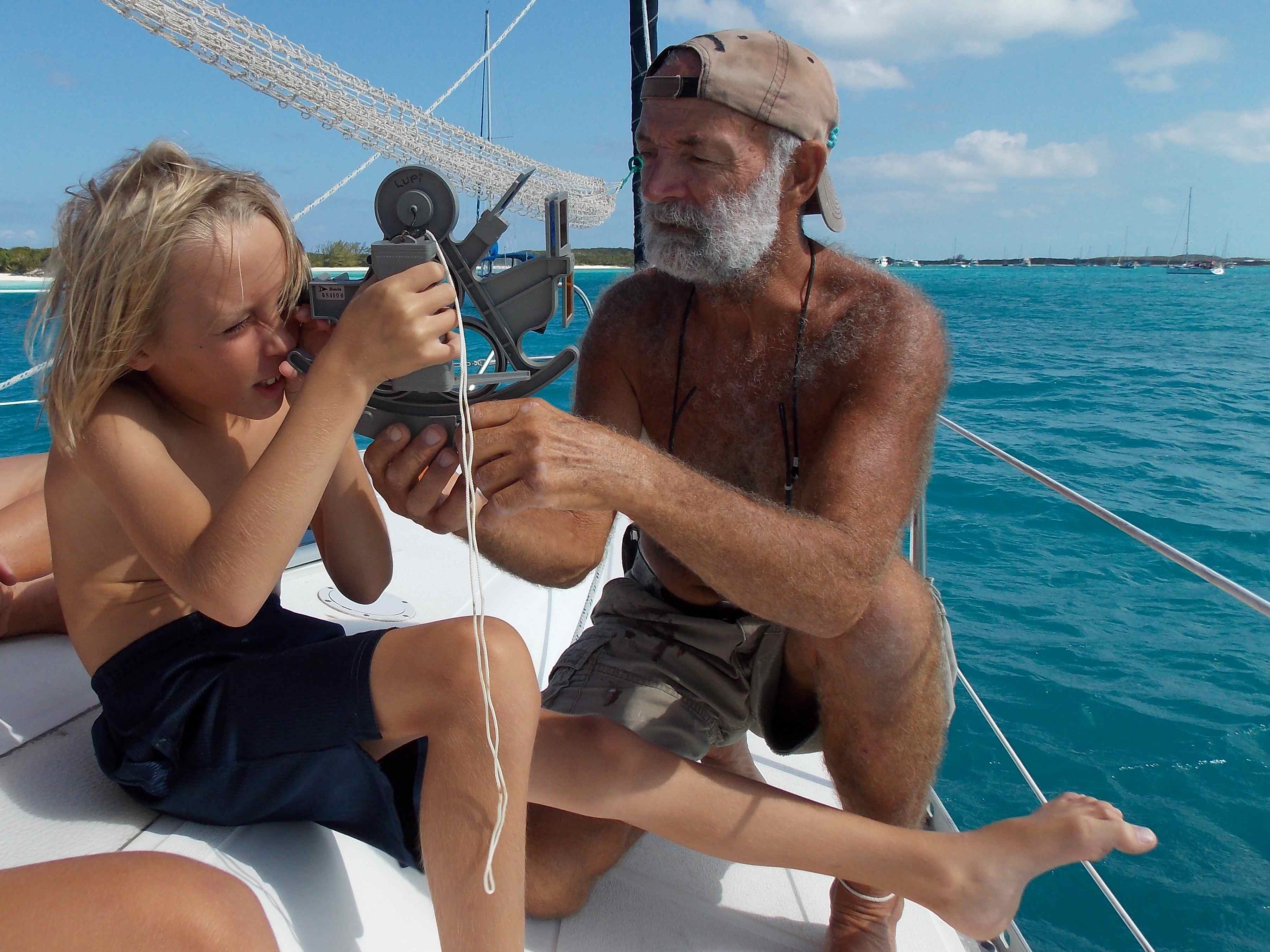
A sextant is a tool that can help you calculate your position. Our friend David brought a sextant to our boat and taught us how to use it. You use mirrors on movable arms to bring the sun down to the horizon to get your fix.
Our friend David from s/v Mist teaching us to use a sextant.
Here is me using the sextant. You use the colored filters to make the sun darker, otherwise it will blind you.
This is my first fish I speared. It is a Blue Stripped Grunt. There are lots of them around so they are easy to catch because they are so tame. In the background there is a few other people that we went spear fishing with too. Usually we go to our friends boat and have a fish dinner with the catch of the day. The next picture is of all the fish all of us caught in the dinghy. I also caught the silver fish, they are another kind of grunt.
The spear I am using is not the kind where you pull the trigger. You pull back a rubber band really tight and then you let it go to spear the fish. It is called a Hawaiian Sling. I think spear fishing is easier than regular fishing because the fish are so tame. As soon as you catch a fish, you put it above the water because they will wiggle right off your spear and then you will have to get them again. This also keeps the blood out of the water otherwise you may attract sharks. If you do, you just give your fish to the shark and get in the dinghy and go.
My first fish.
Our catch for the day.
There is some locals around the islands that will go out spear fishing also. They come back with mostly conch, lobster and 1 really big fish. It is amazing how many they come back with. The picture of me holding a lobster, the locals speared that one but I am going to spear my first lobster soon I think. My dad also has speared some lobsters, not quite as big as this one but they are pretty big.
This is how you find lobsters. You look for little black twigs in rocks under water and those are lobster antennas. Also if you see a hole in the coral, go down and look in the holes and there will be lobster in there too sometimes. They do not run away. They will sit there until you actually touch them.
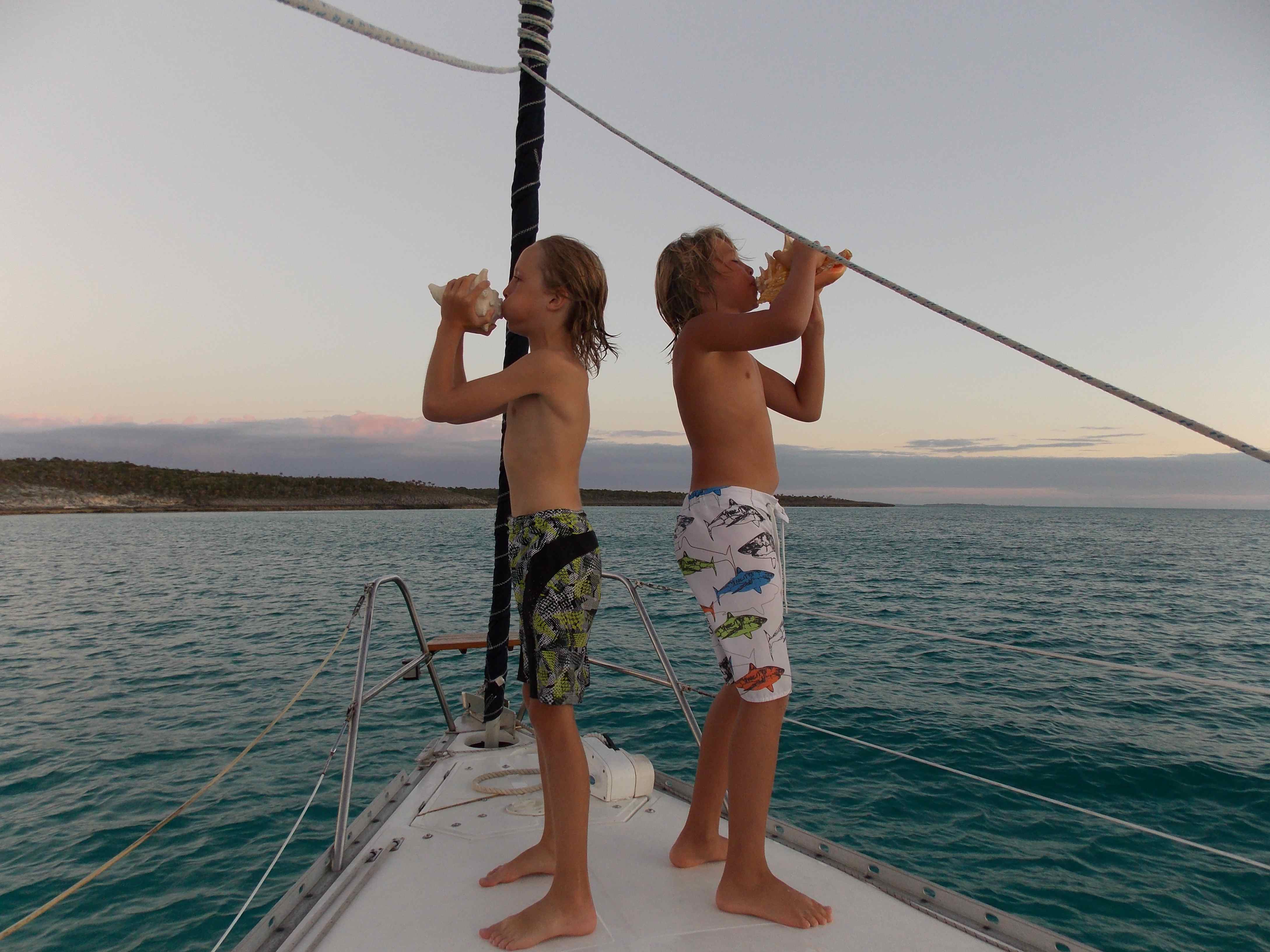
Every evening at sundown we blow the conch and all the other boaters blow them at the same time. It sounds really cool with the echoing in the bay. A conch is the shell of a snail but it has 2 eyes and a little foot it walks around on. They are very good eating. To eat them, you cut a hole in the side of them at the 5th ring to get them out. If you want a conch horn, you have to seal up that hole you made with some putty then at the 4th ring, you cut the top off the conch and it will look all spirally inside. With a chisel, you hit the spiral out of it so it just looks like a funnel.
Conch shells are used for many different traditions. One is at sunset, some are at weddings and a bathing ceremony. These traditions take place in The Bahamas, The Caribbean and Hawaii. Here is a picture of our conch. This is the first one we caught.
Blowing of the conch shell is a tradition at sunset. This is the conch Mark caught a few days ago. The shells all make a different sound. It is somewhat like an elk bugling.
Cole & Logan blowing conch shells.
There are some conch that are good to eat and some that are bad to eat. The good type is a Queen Conch. The type you don’t want to eat is a King Conch. The King Conch look a lot more beautiful but they do not taste so good. You can’t eat any conch that are in 20 feet of water (deep water). They are called black conch. They are the regular Queen Conch but if you eat them from deep water, it will make you sick.
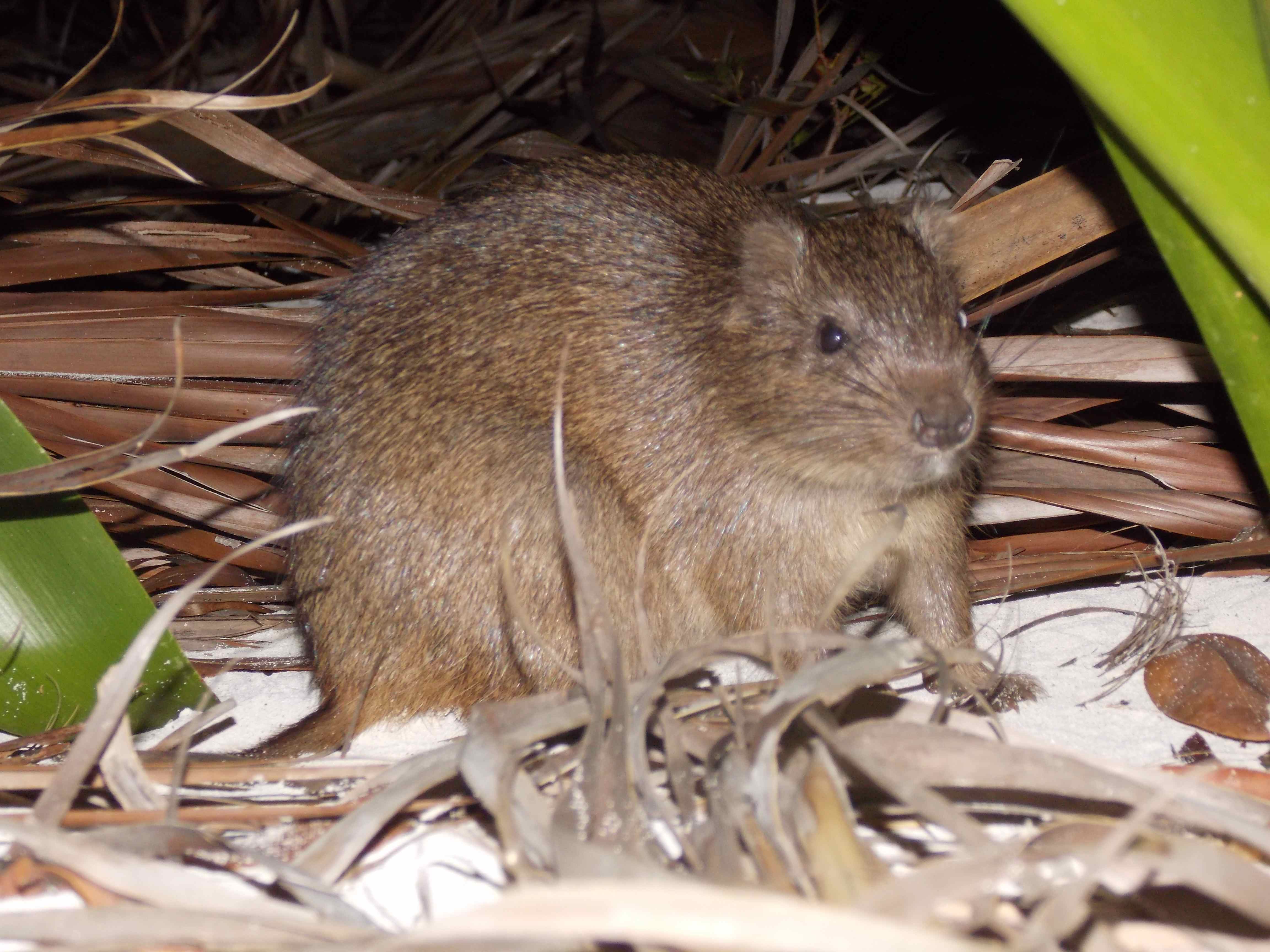
When we were at the beach at Warderick Wells we saw the Hutia. They look like guinea pigs with a rats tail. The hutia are nocturnal and you can get a little close to them.
The hutias are vegetarians. Usually rodents become aggressive when they are living in crowded conditions. Bahama hutias can live close together without getting aggressive.
Bahama Hutia
People used to think they were extinct but really they were alive. They are the only land mammals native to The Bahamas. Hutias are an endangered species and the reason they are endangered is because the Indians that used to live here ate them.
Over the year we will be gone, we have been homeschooling our boys on the boat. The experience has been great so far in that we have had the opportunity to show our kids practical applications to many of the lessons we have been teaching. For example, a discussion about latitude and longitude is concluded by plotting our position on the chart. We talk about the relationship between degrees, minutes and seconds and they get to take turns reading our position on the chartplotter as well as plotting our position on the chart throughout the day.
Mark and Cole plotting our position.
For Christmas the boys received an invention kit from Radio Shack. The kit included the materials to make simple motors, a radio, a telegraph and a number of other inventions. We invited some of the other cruising family’s kids onboard to make the telegraph. We incorporated some of the literature we picked up at a pony express station in Nebraska because it was the invention of the telegraph that made the pony express obsolete after only 18 months of operation.
A successfully built spinning motor.
Our lesson using the telegraph lent itself to learning about Morse Code. The next day the kids used flashlights to send messages using Morse Code to one another. The trivia question for the day is, what does SOS stand for?
And so goes learning on a boat. We learn about radios and then we use them in a practical application.
This week we have been held over at Black Point in the Exumas . While here, the boys are going to the local school. The kids in the school have been very friendly and the teachers and principal were open to having any of the cruising kids attend while we are here.
Helping out in Black Point.
Christine and I were invited to help out in the school as well. She has been helping with some of the kid’s reading, while I gave a short lesson to the class about energy and simple machines. I brought in a chisel/wedge, a pry bar/lever as examples of simple machines and scavenged up a wheelbarrow from one of the locals and a propeller and can opener from our boat as examples of compound machines to demonstrate how simple machines can be combined to make more complex ones.
Recess is fun where ever you are.
Meeting new friends at school.
More importantly than the lessons they are learning in class is the experience they are getting by attending school in another country. They are making new friends in a different culture and while that isn’t part of the lesson plan it’s all part of the experience. Who knows if they well ever study abroad, but if they do now they have at least a taste of what they could expect it to be like. We thank the teachers and kids at Black Point for inviting us into their school.
12/17/12 We left Nassau next for Allen’s Cay. David on s/v Mist sailed along with us. Allen’s Cay is known for their iguanas.
Coral heads as we approached Allen’s Cay. We have read about them and when you see them, you know it. We are always on the lookout for these dark, dangerous spots.
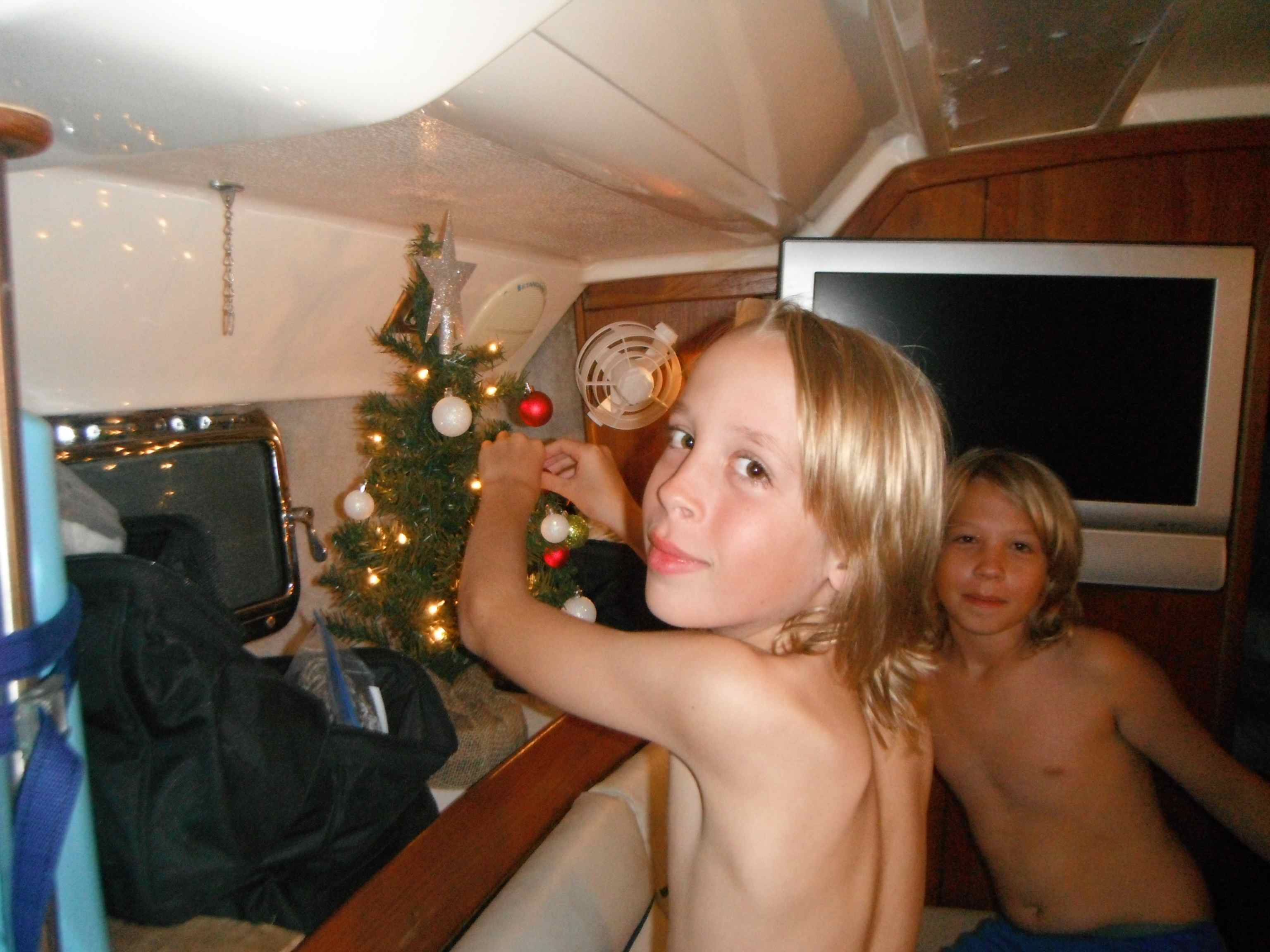
Sailing into the bay, we could see the famous iguanas on the beach. We wasted no time in getting the dinghy in the water and headed for the beach. (See Cole’s post on the iguanas). There were some good snorkeling spots here as well with beautiful coral heads and fish. It is hard to believe Christmas is just around the corner. We put a Christmas tree and decorated it on the boat.
X-Mas tree on Truansea.
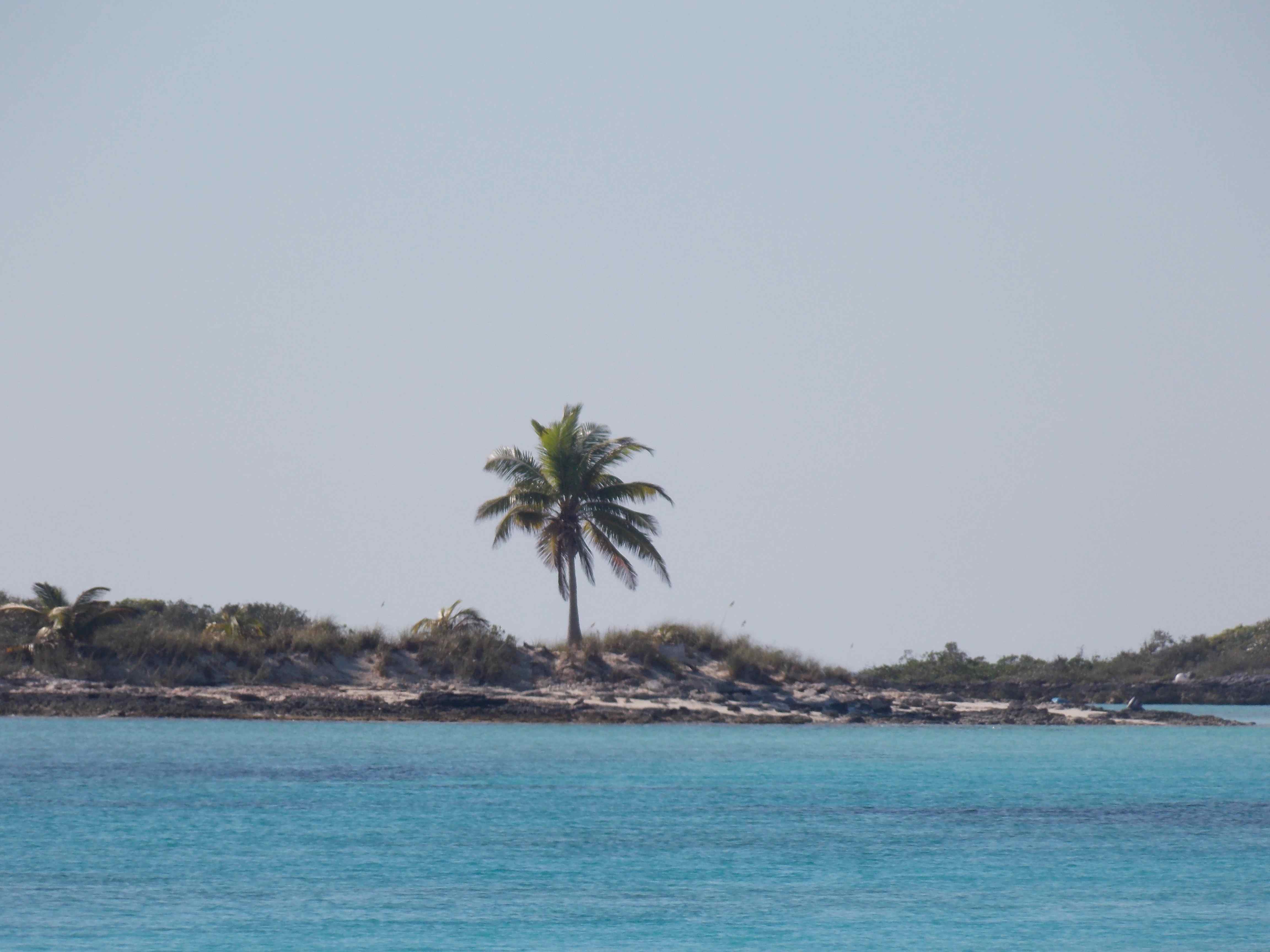
Lone palm tree on Allen’s Cay.
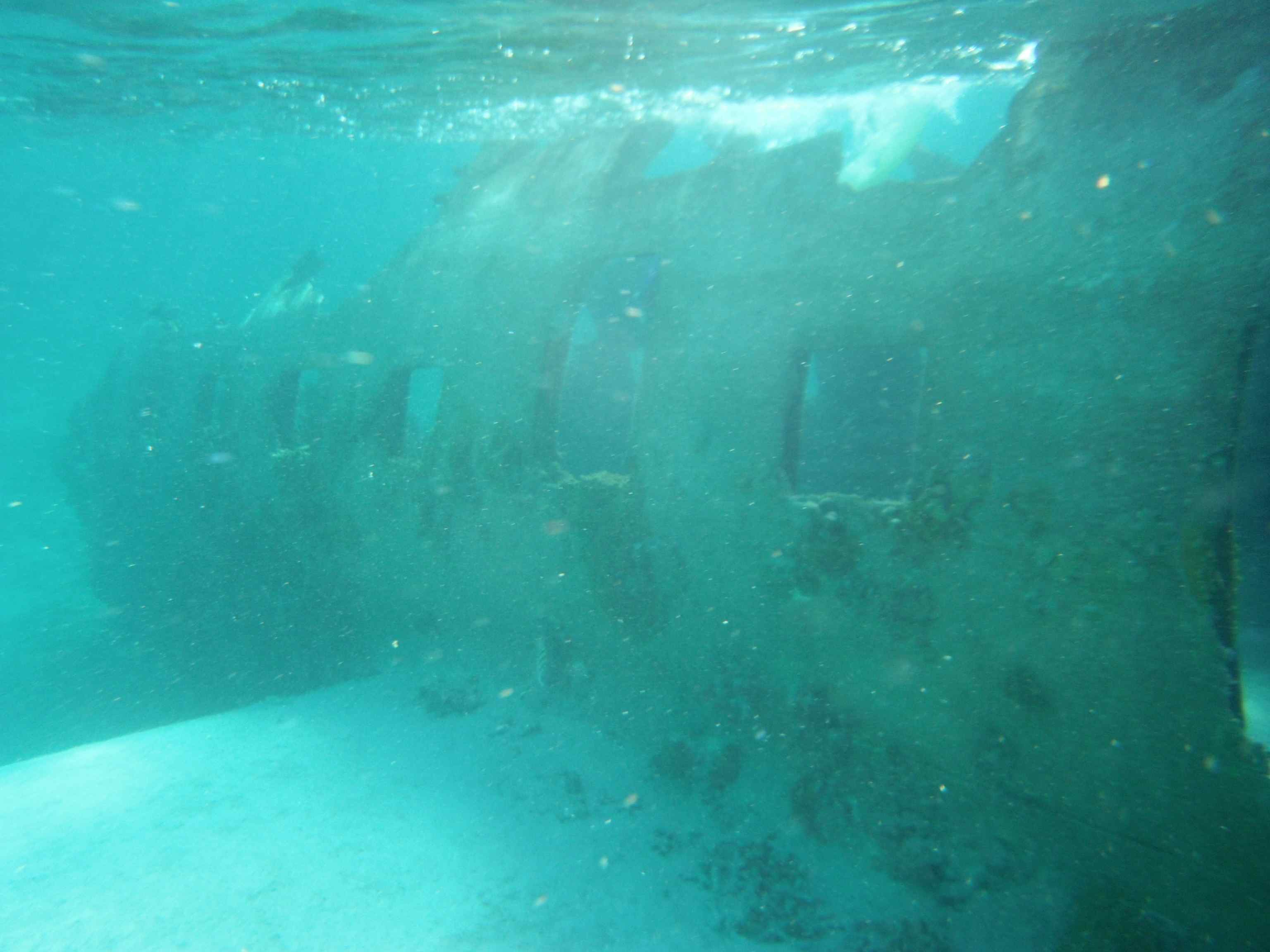
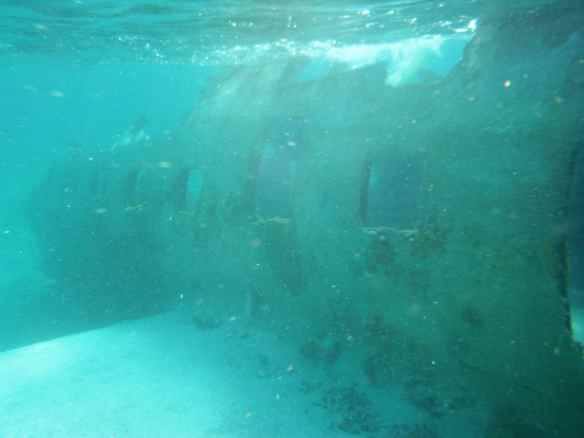
12/19/12 We headed for Norman’s Cay to get protected anchorage from the high winds forecast coming up. We tried to get into Norman’s Pond, which is very protected, but kept getting stopped by the sandy bottom. We knew it was a shallow entrance and several people told us we could make it with our draft. The channels are ever changing and evidently it has filled up enough that 5’ drafts can no longer make it in. We anchored near the submerged plane wreck and dived it at slack tide. Beautiful fish, coral life, stingrays and nurse sharks are living in and around the wreck.
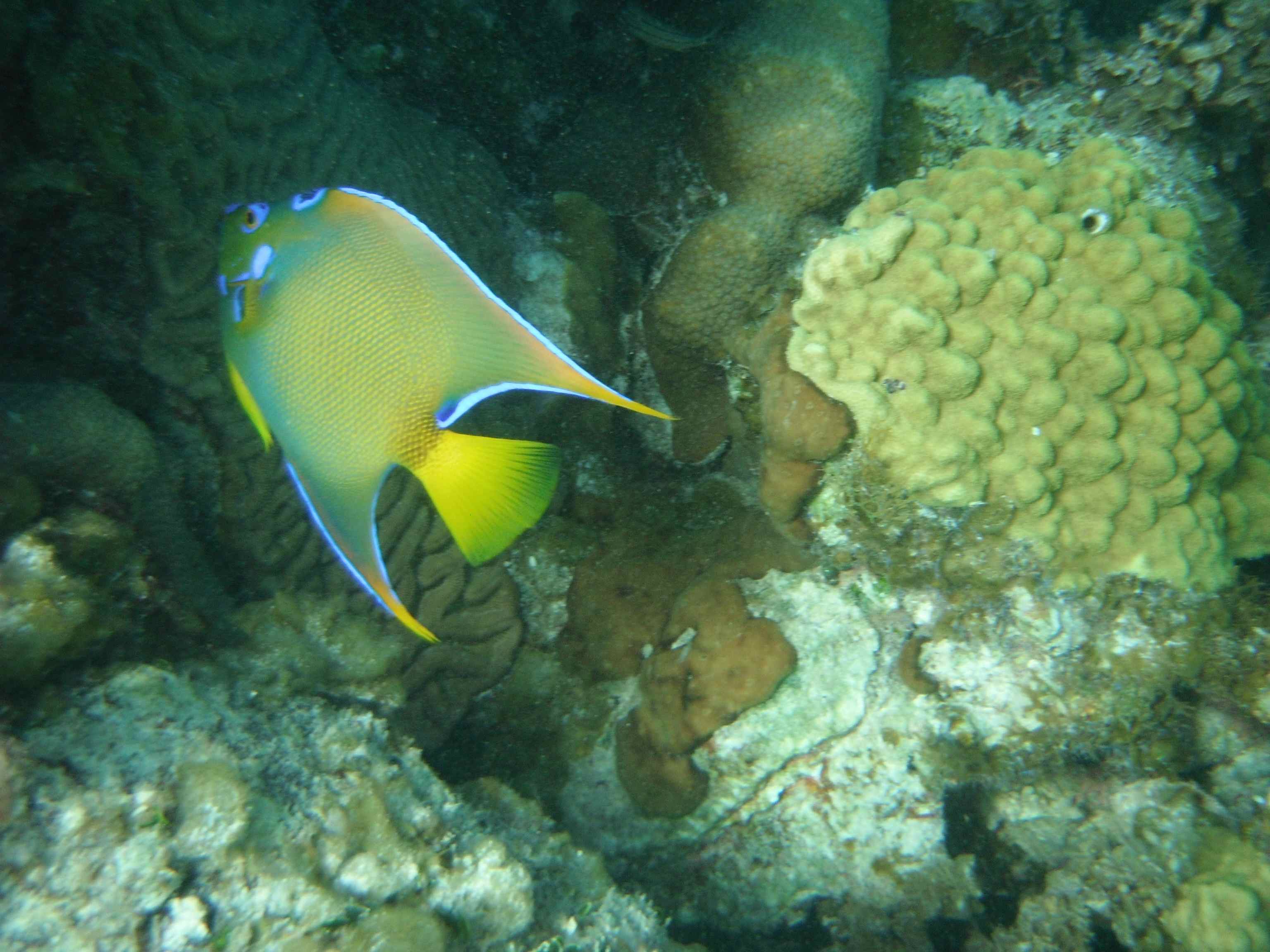
One of my favorite fish.
Plane wreck we dove at Norman’s Cay.
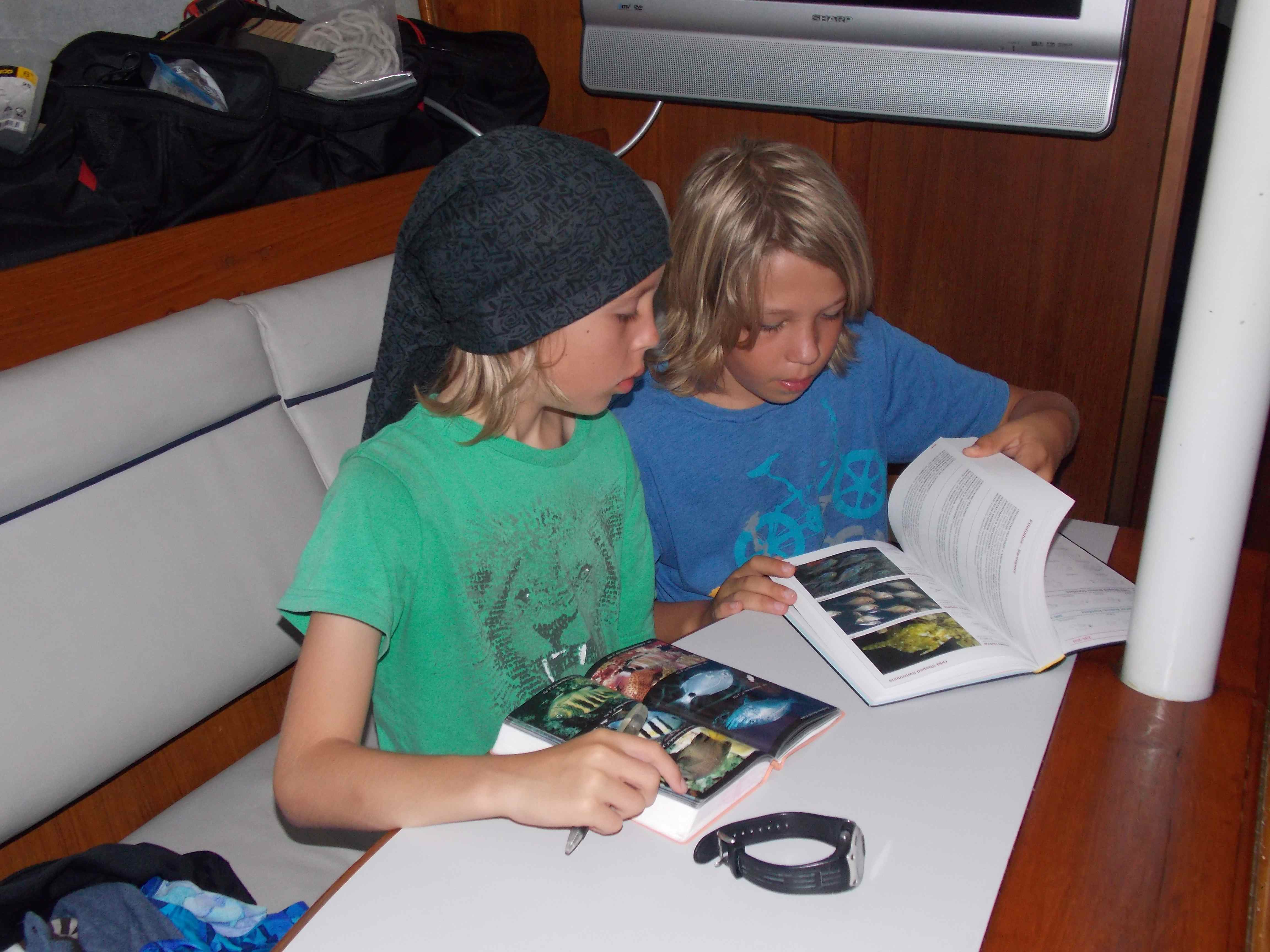
After snorkeling, the boys (and us) head for the fish books to identify what knew sea life we saw.
Mark cooking on our camp stove in the companionway.
12/20/12 The next day we went to Warderick Wells Cay. You can anchor here, but have to anchor a ways out so we picked up a park mooring ball to be close to the beach and hiking trails. Their mooring balls are regularly maintained so we felt secure here as well with the winds picking up. Warderick Wells is part of the Exuma Land and Sea Park which is a no take zone. Nothing living or dead may be removed from the park. There was beautiful, diverse snorkeling spots here which we went to on several different days. Our favorite spot was called Ranger’s Garden.
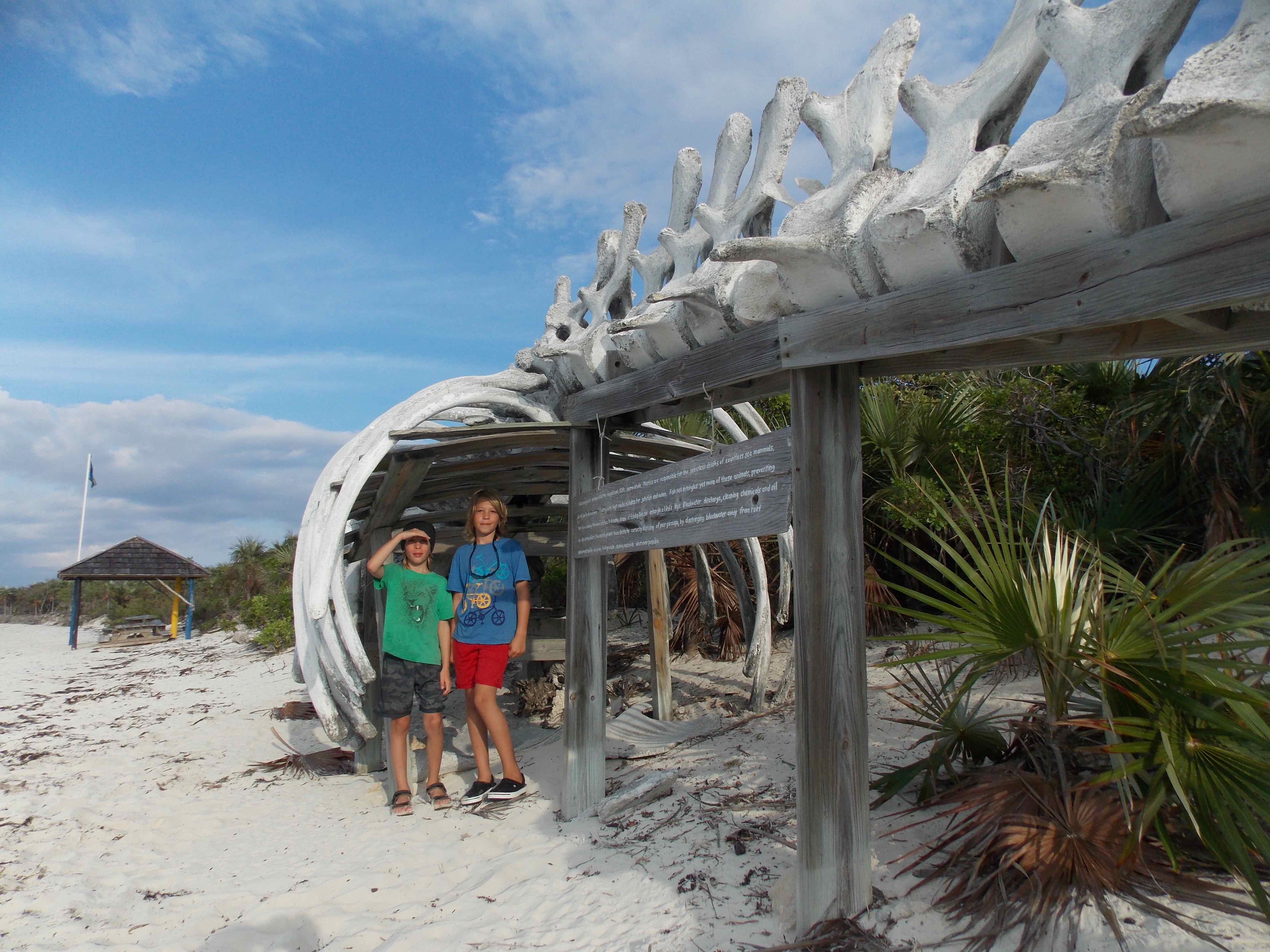
Whale bone skeleton at Warderick Wells Cay.
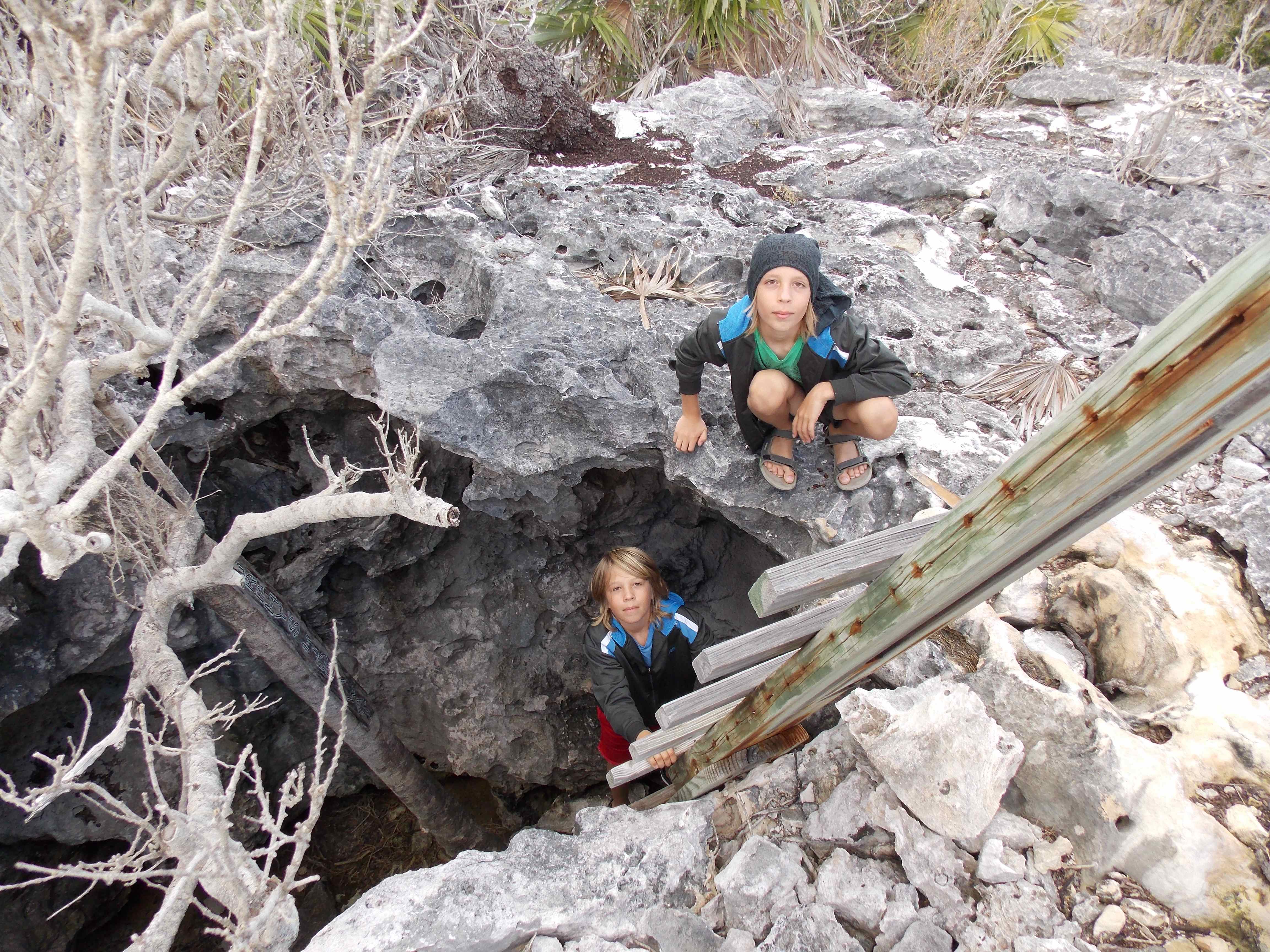
The hiking at Warderick covers diverse terrain. We made driftwood placques to leave at BooBoo Hill to appease the wind gods, had fun sticking our heads over the blow holes, made a palm hut, did beach combing and hiked a variety of trails.
The legend of Boo Boo Hill.
There are a variety of beaches here as well. The kids made a palm tree hut on one of them.
The park warden hosts a Christmas dinner at his house every year. He cooks the ham and turkey and everyone brings a dish to pass. Needless to say, the food was fantastic and the cruisers company was even better.
Cole climbing a palm tree. He keeps me supplied with coconut milk!
12/27/12 Our next stop was Cambridge Cay and our friends Graeme and Laura on s/v Sweet Chariot joined us. We snorkeled five different sites here, one with a cave, another plane wreck and our favorite place was called The Garden. It was the most beautiful spot we have been to yet. The best part of it was we saw a sea turtle. We watched him peacefully munching sea grass then swam gracefully away.
A different kind of school…
Cole snorkeling.
12/28/12 On to Big Majors Cay after stopping at Staniel Cay to top off on diesel, gas and water, then spend some time seeing the area. We rang in the New Year’s here with some fantastic new cruising friends – Laura, Graeme, Sean, Candi, Nick, Morgan, Chip, Eleana and John.
Cruising friends on Eleon. Logan, Eleana, John and Cole.
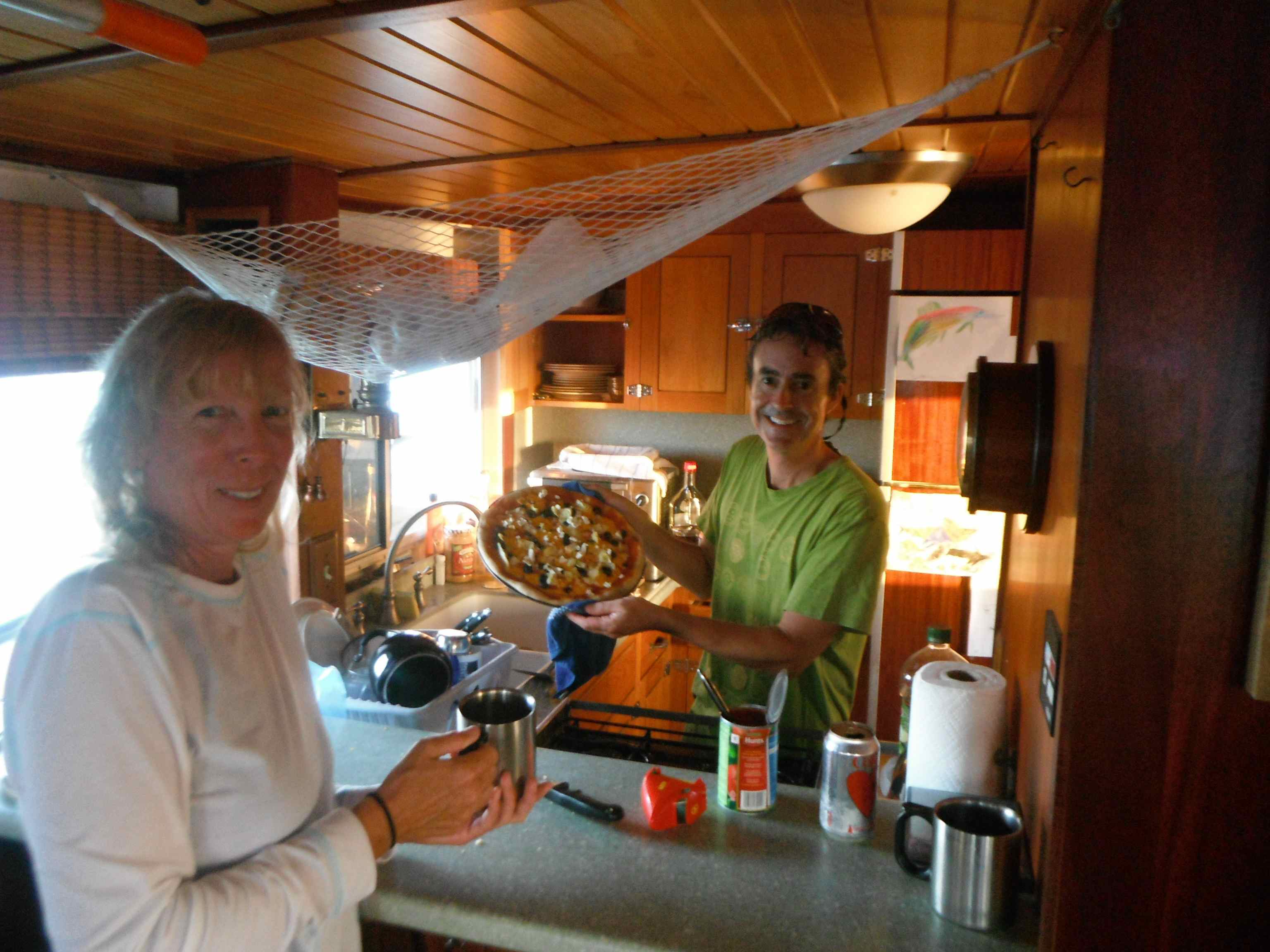
Pizza birthday party on Eleon. Chip is a fantastic cook!
The starfish are big and beautiful. David, Logan and Cole.
The winds picked up for a couple days. We are glad we purchased a Rocna anchor and 70′ of chain.
The Rocna anchor buried to the bar. I love to see it buried (helps me sleep better).
The famous Thunderball Grotto (for all you James Bond fans). Unfortunately the club is still not open.
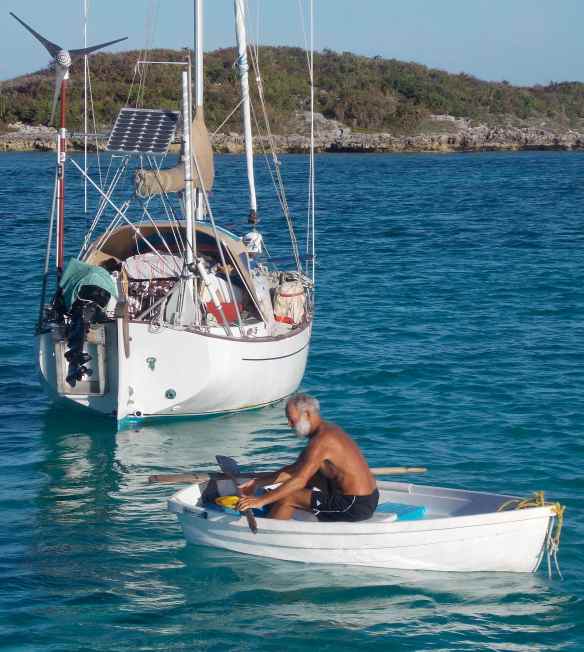
David rowing to Truansea for supper. “The real deal sailor,” as the boys call him. He taught us to play Rummy 500 which we thoroughly love but changed to Rummy 300.
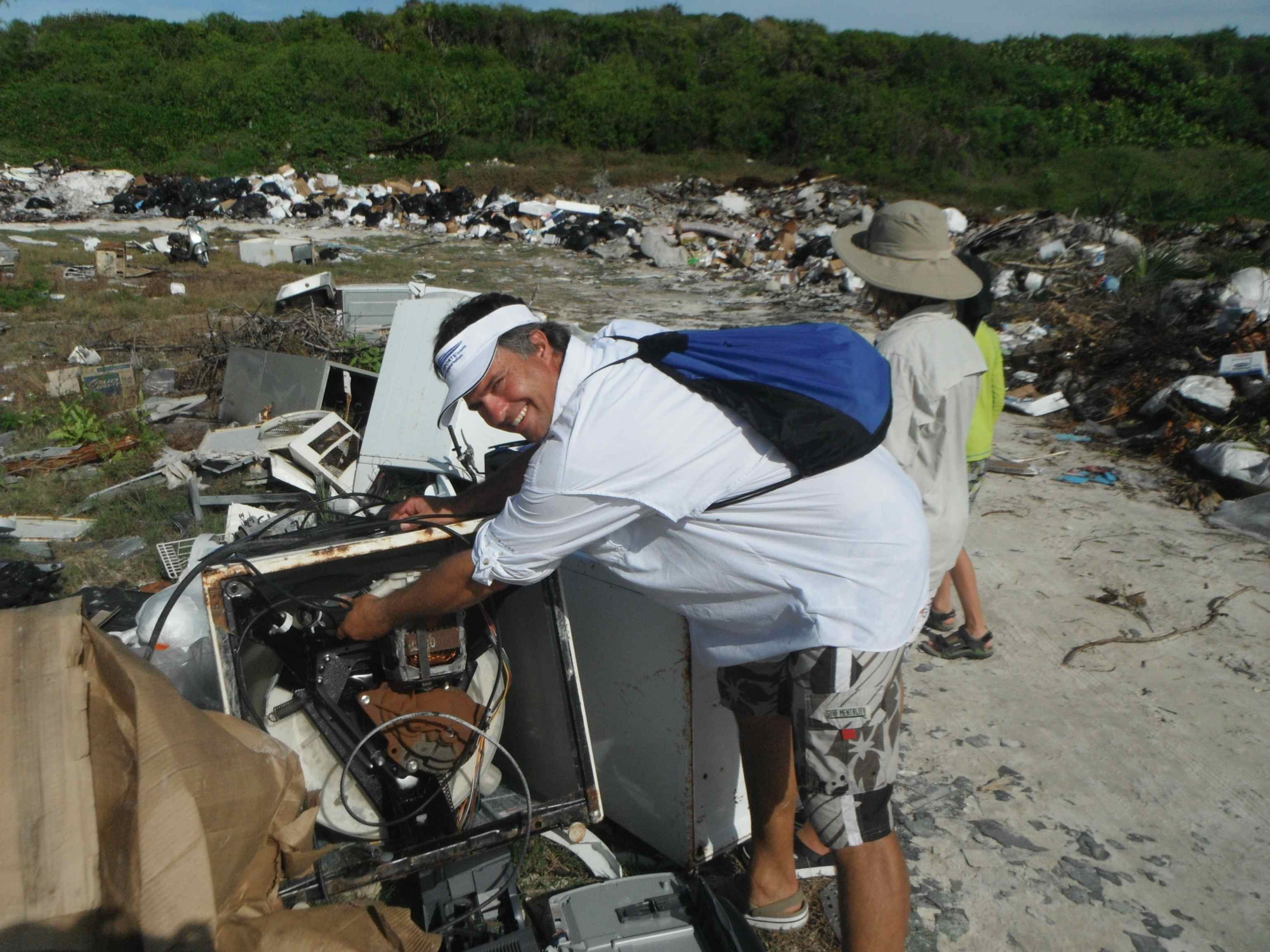
We walked to the dump to drop off our garbage and Mark found a few parts needed for the boat!
The colorful houses are so much fun. Maybe we will update the color on our Mossy Cup Street house when we return to Idaho! What do you think Paul & Mary?
Mark with the catch of the day, 2 lobster and 1 conch.
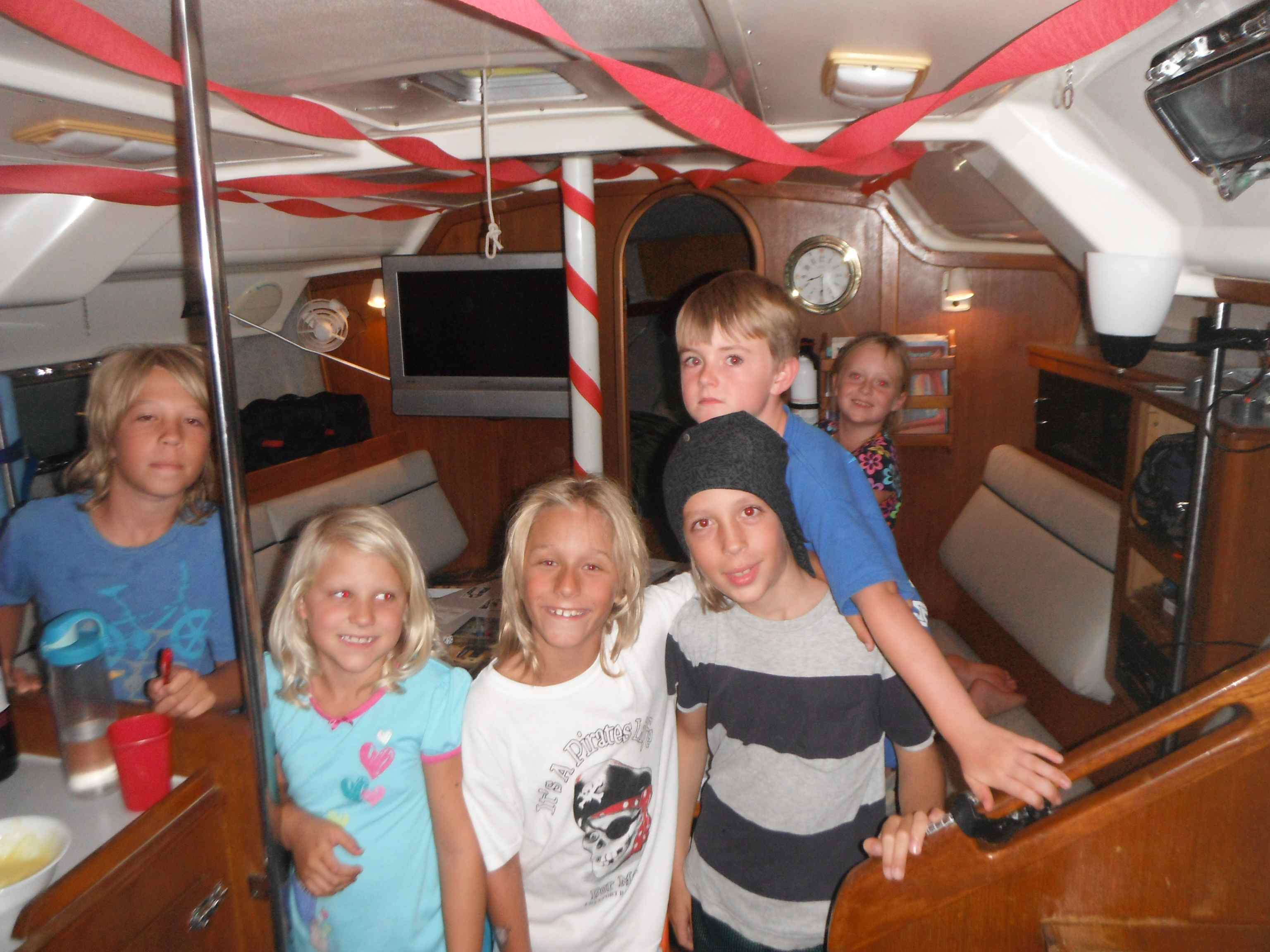
New Year’s Eve party. John, Morgan, Nick, Cole, Logan and Eleana.
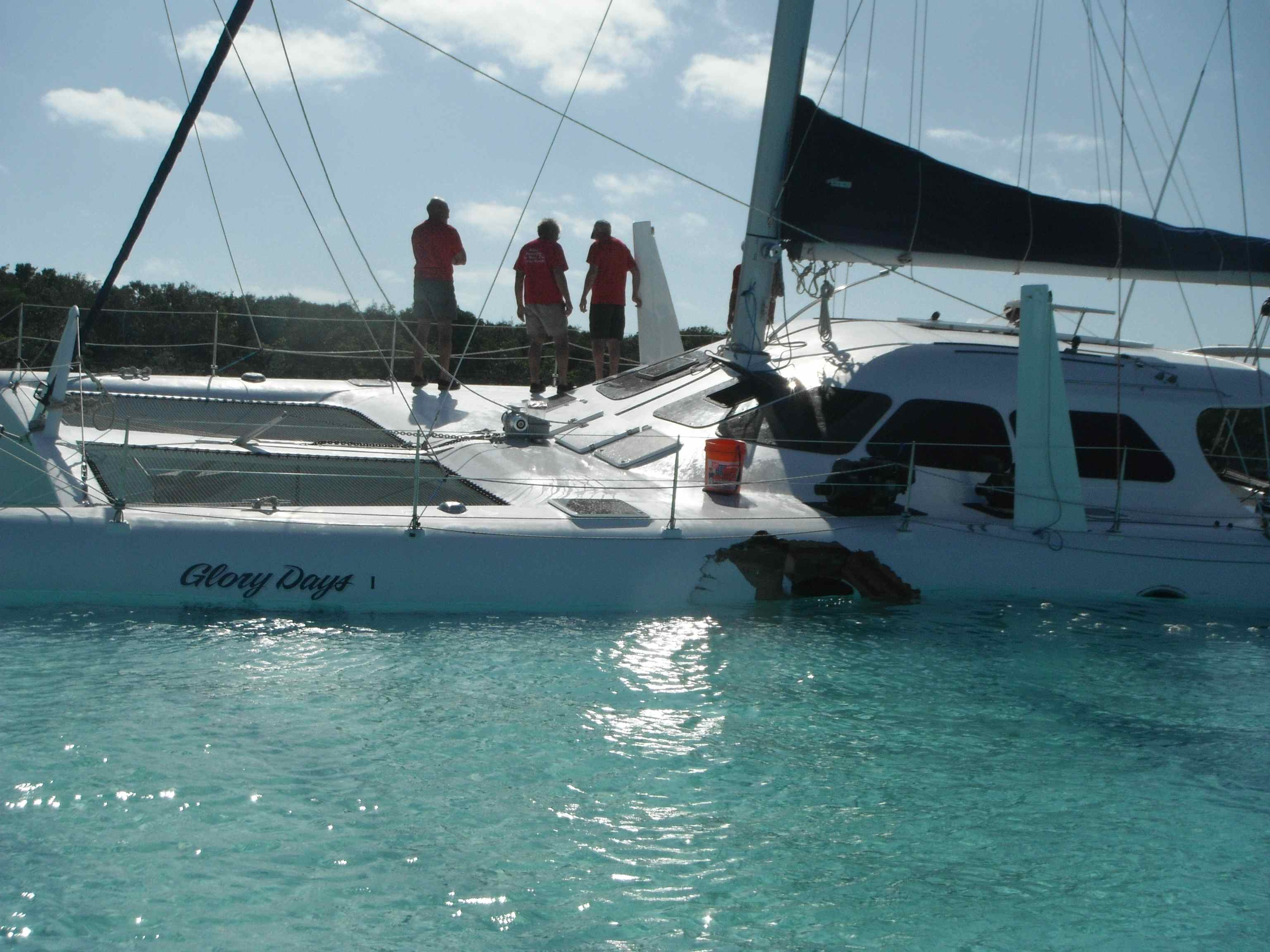
Catamaran after a collision during the New Year’s Day regatta.
01/02/13 Off to Black Point on Great Guana Cay.
Logan doing school work on Truansea on the way to Black Point on Great Guana Cay.
Cole hard at work.
01/04/13 On to White Point to anchor in a bay with boat friends and do some snorkeling and fishing. We explored the beaches and did some hiking as well.
01/06/13 We headed back to Black Point on Great Guana Cay. The winds are supposed to pick up so we are holing up here until the winds drop back to my comfort level. It looks like the winds will stay for a while and we may be here over a week.
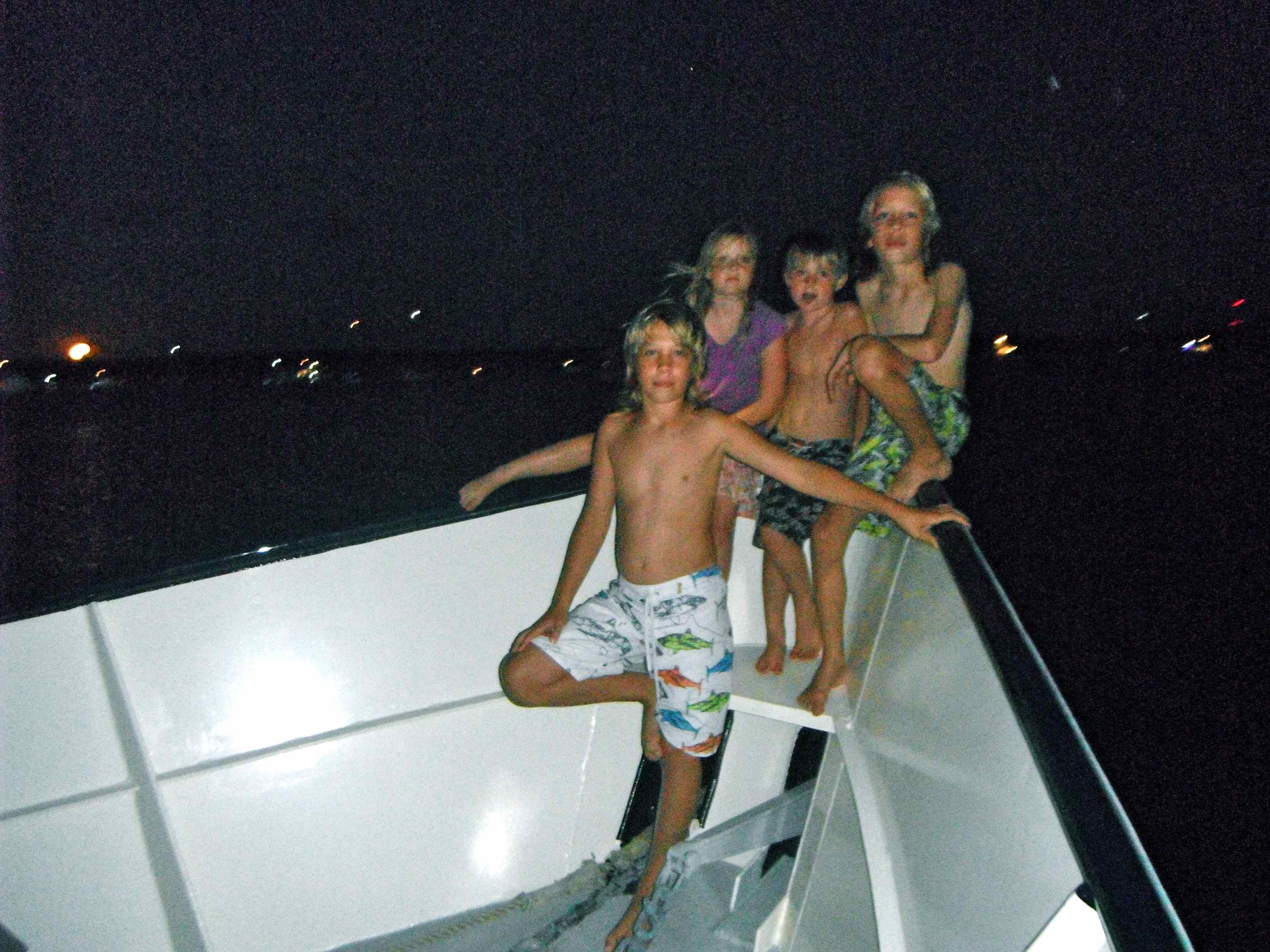
This is Cole’s favorite spot on the bow of Truansea.
Blowing of the conch shell is a tradition at sunset. This is the conch Mark caught a few days ago. The shells all make a different sound. It is somewhat like an elk bugling.
Cole & Logan blowing conch shells.
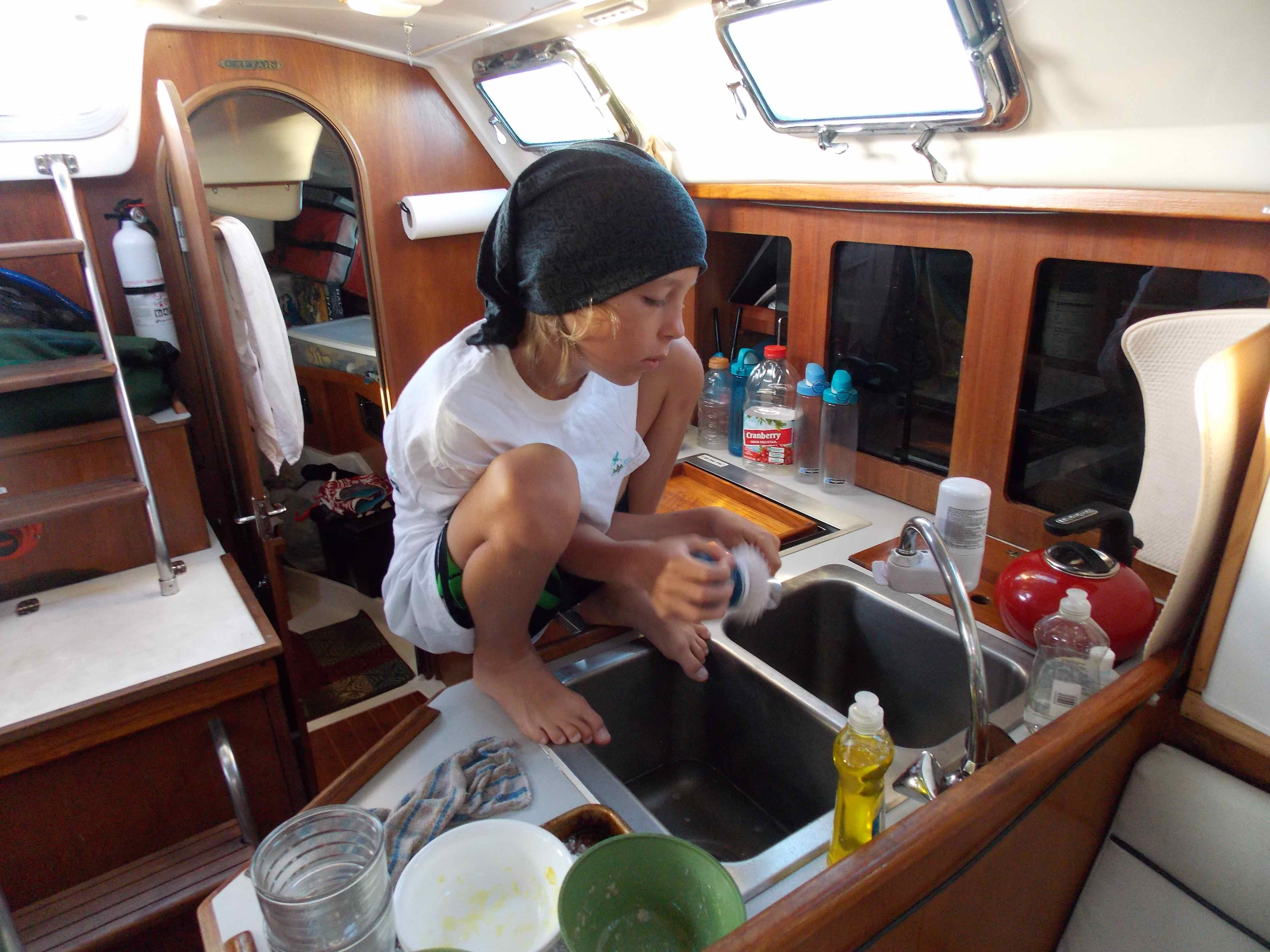
Cole’s perch doing dishes.
Breadfruit on a breadfruit tree.
We are all happy that some cruising kids are holed up at Black Point with us. They love to dive off the bow of the boat, swim around to the transom, walk the side decks to the front of the boat and do it all over again and again and again! Happy,tired kids and parents at night.
Class on the telegraph machine on Truansea, incorporating the pony express and morse code into it. The kids are going to send morse code messages by flashlight back and forth between boats tonight. Nick, Elana, Cole, Logan, John and Morgan.
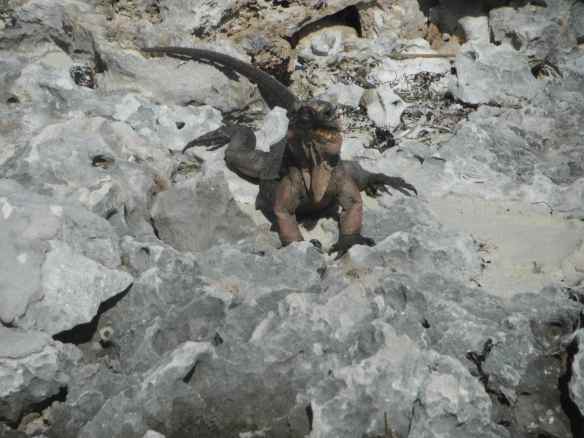
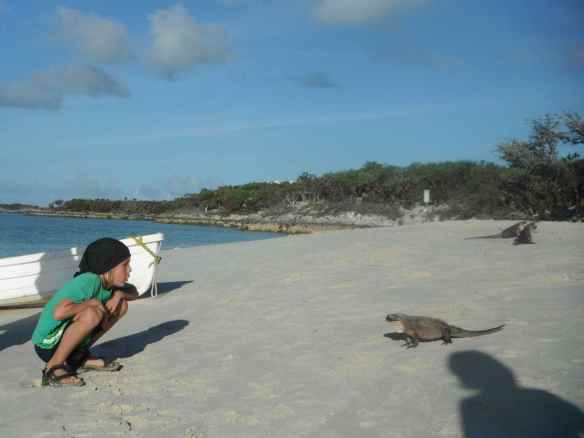
The Exuma Iguanas are among the world’s most endangered lizards and are found nowhere else. They live on two islands in the Exumas. We went to the beach on Allen’s Cay and saw the iguanas. When we pulled up in our dinghy, a bunch of iguanas ran out of the trees towards us.
Iguanas on Allen’s Cay.
The iguanas look like dinosaurs and can live to be 80 years old. They can weigh up to 24 pounds.
Here is a picture of me on the beach with the iguanas.
Cole with the iguanas.
Exuma Iguana.
They can lay up to 10 eggs in the sand and hatchlings emerge from the nest after 80 days.
We have done some snorkeling along coral reefs. When we snorkel, the thing we always see is a Sergeant Major fish. The first picture is of a Sargeant Major. We also see lots of stingrays, Spotted Eagle Rays, angelfish, tons of Parrot Fish and sea turtles. One of the things I haven’t seen but I want to see is a green moral eel and a seahorse. A little while ago snorkeling, we found a pirate coin buried in sand. It is really cool, it has lots of engravings on it.
Sergeant Majors
Some of the coral reefs are dying from bleaching. Bleaching is when the water gets warmer every year and coral starts to turn solid white.
We have snorkeled plane wrecks and ship wrecks as well. A picture of the shark is by a shipwreck.
Plane Wreck
Shark
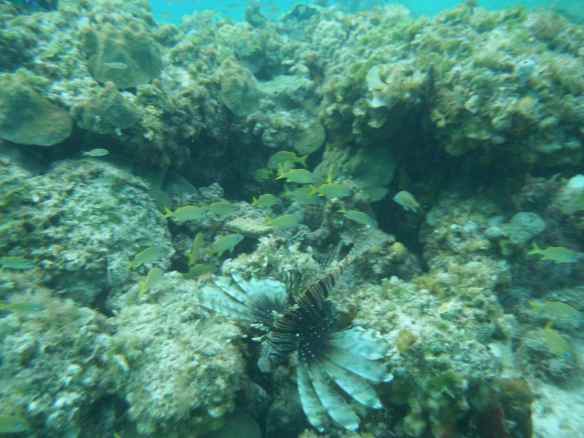
Here are some of the pictures of the reef fish.
Reef fish
Angle Fish
Lobster
Lion Fish
Here is a video of a Spotted Eagle Ray. You can’t see its spots in the video but it is black with white spots all over. You have to be careful with the rays because they have a barb at the end of their tail that could get you. They are cool just to watch.
We arrived in Nassau at 11:00AM this morning, our crossing from Bimini took us 21 hours and was about 120 nm. We fueled up at the Nassau Harbor Club and took on 11 gallons of diesel averaging just over .5 gal/h
“Ten Years After” Sailing with us to New Providence Island.
After anchoring east of the fuel docks we all jumped in the water to cool off. The boys watched eagle rays gliding along the bottom while I cut away some monofilament line that was wrapped around the prop shaft.
12/14/12
Woke up this morning to a change in the feel of the motion of the boat. Going up on deck confirmed my suspicions that we had run aground! Being low tide we were fairly certain that we would float off by morning, but still, it was disconcerting to have run aground and visions of towing bills danced in my head.
12/15/12
Morning came and we were all happy to see that our boat had also risen with the tide. We hoisted our anchor and wasted no time motoring to the Atlantis Resort.
We spent the day at the water park and were thoroughly exhausted by evening.
Atlantis, sharks and water slides, who would have thought!
Staying at the Paradise Island Marina turned out to be a good value. The slip cost us $4/ft and there was a 40ft minimum but for $160 we also received free admission to the water park.
12/16/12
We took showers, checked the weather and did our laundry before checking out of the Marina and relocated to our old anchorage but this time in a little deeper water.
We put out more rode and set the anchor and felt confident that we had picked a better spot for the night.
That evening we invited a boat neighbor over for dinner. Just seeing the boat that he was sailing was enough to tell me that he would have a few stories to tell. David’s boat was a Pacific Seacraft Flicka, a 20ft boat capable of crossing oceans. We listened to David tell stories about crossing the Atlantic ocean in his Flicka “Mist” to the Azores and beyond. He told us how he used to dive for abalone and his encounters with great white sharks and the seals that would hit you from behind to steal your shells. If you knew what was good for you the smartest thing to do was to let them have them and get out of there.
David had lost 7 boats to hurricanes and just about the time I started thinking that some of his stories might be a little too fantastic to be completely true a squall blew into the harbor and our anchor started to drag. David thought that out rode had wrapped around our keel so I put on my snorkel and fins and dove over the side to clear the keel. By the time I surfaced David had hopped into his dingy and rowed out to unfoul our anchor which had wrapped around his own anchor line. He lifted our 70ft of chain and anchor not once but twice into his dingy and reset out anchor before rowing back to our boat and calmly said to my wife. “And that is why I remain so fit!”
David getting ready to row away from “Mist”.
That a 73 year-old man could row out at night, in a squall and rescue our boat was more than a little like watching superman swoop down out of the sky and lift a plane about to crash back to safety.
The worst of the winds passed and we were all eating spaghetti when I noticed a brightly lit boat pass our stern. We all went up into the cockpit and watched a Christmas parade of boats traveling up and down the eastern channel blasting music and fireworks into the night sky.
I did not take the time on the previous posts to get many pictures out about Bimini and none of the Nassau crossing so following are some catch up pictures.
Main street of Alice Town on North Bimini.
Pier on Bimini where we moored. Doesn’t it look tropical?!
About 2 hours into our passage from Bimini to Nassau.
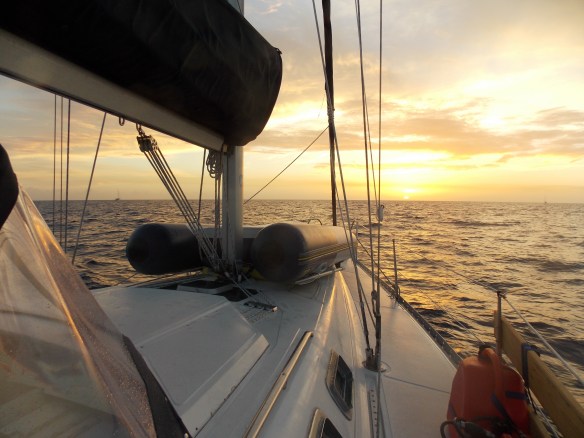
Sunsetting off the stern of Truansea. You can see one of our ‘buddy boats’ in the background. It was reassuring to have a couple other boats to see and talk to throughout the night.
Sun rising off the bow. Morning finally arrived!
Crew waking up in the morning. They opt to sleep in the cockpit where seasickness is not so apt to get you. Logan woke up several times throughout the night to help out with the passage. Cole has liked sleeping on the floor of the salon or the cockpit since he was a baby. We are just careful not to step on him!
We filled up with fuel on the way in, found a place to anchor and changed into our swim gear to cool off and snorkel around our boat. We were quickly greeted by marine life. The most exciting was the Eagle Rays and Mark was greeted by a barracuda peeking at him around the keel of our boat.



























 Truansea